
You are likely here because you have a voice in your head that refuses to clock out. You watch a movie, but instead of enjoying the climax, you are mentally replaying a conversation from three years ago. You listen to a song, and instead of enjoying the melody, you are dissecting the hidden meaning of the lyrics.
Society calls this “overthinking.” They call it a problem. They might even call it a disease.
But here is the unfiltered truth: There is absolutely nothing wrong with you.
If you are an overthinker, you do not have a broken brain. You have a high-performance engine that is currently stuck in the sand. The engine is revving, the wheels are spinning, and the noise is deafening—but you aren’t moving forward.
This article will break down exactly what overthinking is, the biological and psychological reasons it happens, and how to distinguish between “genius thinking” and “destructive overthinking.”
The “Overthinking” Myth: It’s Not About Quantity
Most people believe overthinking means “thinking too much.” That is a myth.
If thinking too much were the problem, scientists, philosophers, and inventors would be the most miserable people on earth. But they aren’t. It was “thinking a little more” that led to the invention of the wheel and the discovery of fire.
The problem isn’t the volume of thoughts; it is the direction.
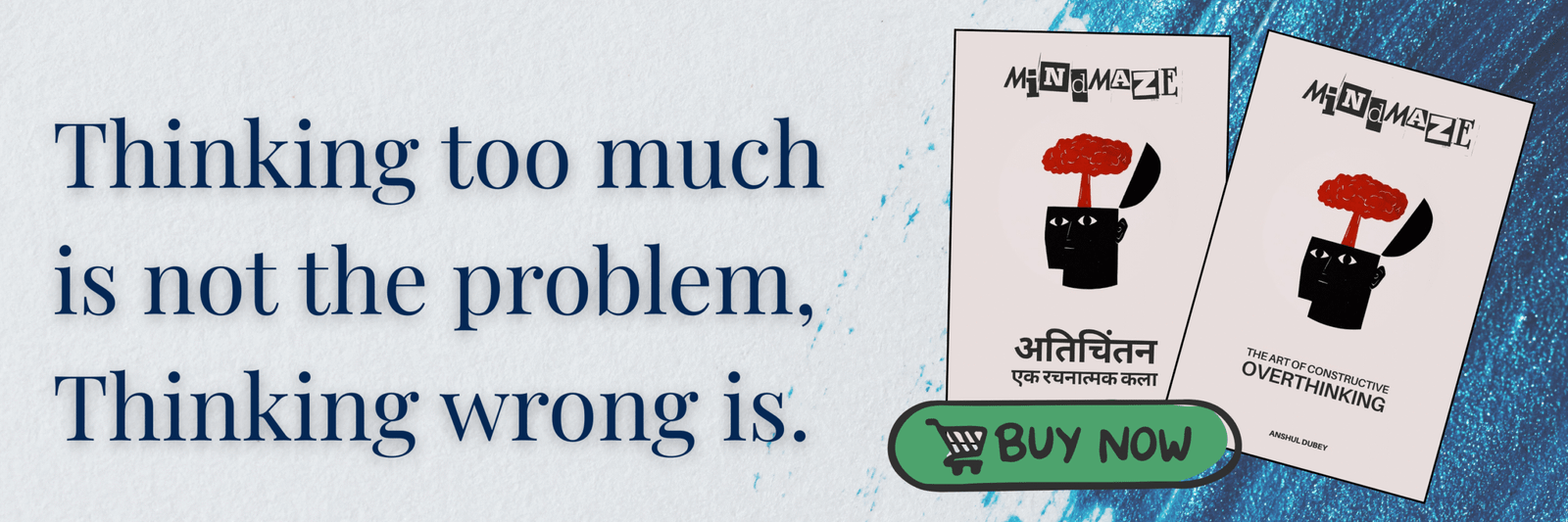
As explained in the book MindMaze, thinking is the mind’s default function—it keeps us alive. The issue arises when the mind starts “thinking in the wrong direction”.
Constructive Thinking (Planning): You face a problem, and you think about actionable steps to solve it. You prepare for the future based on reality.
Destructive Overthinking (Worrying/Rumination): You abandon the present moment to live in a scary fantasy of the future or a regretful memory of the past. You try to solve problems that haven’t happened yet.
The Neuroscience: What is Happening Inside Your Brain?
While MindMaze simplifies this to avoid overwhelming you with jargon, it is important to understand the machinery if you want to master it.
When you overthink, a specific battle is raging in your brain:
1. The Default Mode Network (DMN)
This is your brain’s “autopilot.” When you aren’t focused on a specific task, the DMN lights up. It is responsible for recalling memories and imagining the future. For overthinkers, the DMN is hyperactive. It’s the reason you can’t simply “zone out”—your autopilot is set to “analyze everything.”
2. The Amygdala vs. The Prefrontal Cortex
The Amygdala is your brain’s alarm system—it detects fear and threat. The Prefrontal Cortex is your CEO—it handles logic and reasoning. In a normal brain, when the Amygdala panics (“Did I offend my boss?”), the Prefrontal Cortex checks the facts (“No, he smiled when I left”) and shuts off the alarm. In an overthinker’s brain, this connection is jammed. The alarm keeps ringing, and the logic center gets drowned out by the noise.
3. The Neurotransmitter Loop
Every thought creates a chemical reaction.
Actionable thoughts often release Dopamine (the reward chemical) when you find a solution.
Cyclical worrying triggers Cortisol (the stress hormone). The problem is, the brain can get addicted to the loop. You might unconsciously believe that worrying about a problem is the same as solving it. It isn’t.
The 4 Root Causes: Why Do You Overthink?
You weren’t born worrying about everything. Overthinking is usually a learned behavior or a response to your environment. According to MindMaze, there are four primary psychological drivers behind this habit:
1. The Need for Control
We crave certainty. When life feels unpredictable, the mind tries to gain “imaginary control” by predicting every possible bad outcome. We think, “If I imagine the worst-case scenario, I’ll be prepared.” This is often called Catastrophizing.
2. Past Wounds
If you were hurt or embarrassed in the past, your brain creates a “rule” to protect you. It starts Generalizing. For example, if one relationship failed, your brain might overthink every text message in a new relationship, convinced that “history is repeating itself.”
3. Fear of Failure
This is the perfectionist’s curse. You feel that if things aren’t 100% perfect, they are 0% good. This binary thinking paralyzes you. You overthink an email for an hour because the fear of a minor mistake feels like a total disaster.
4. Lack of Self-Confidence
When you doubt your own worth, you start Mind Reading. You assume others are judging you or thinking negatively about you, even without evidence. You become a “Mentalist,” trying to decode the silence of others, often filling the gaps with your own insecurities.
The Diagnostic: How to Know if You Are Overthinking
So, how do you tell the difference between “Smart Analysis” and “Toxic Overthinking”?
It is actually very simple. You don’t need a brain scan; you just need to check your “Internal Weather.”
The Golden Rule: Thought → Feeling → Experience. Every thought generates a feeling.
Right Thoughts lead you toward feelings you want (confidence, hope, clarity, peace).
Wrong Thoughts (Overthinking) lead you toward feelings you don’t want (anxiety, dread, confusion, helplessness).
Ask yourself: “Is this thought actionable?” If you are thinking about how to fix a mistake, that is planning. If you are imagining the humiliation of the mistake over and over, that is overthinking.
Moving From “Engine in Sand” to “Rocket to Mars”
If you see yourself in these descriptions, take a deep breath. Remember, overthinking is not a life sentence. It is a sign that you have a powerful mind that simply needs a new direction.
If you can imagine the worst-case scenarios in high definition, you also have the creative power to imagine the best-case scenarios. You just need the right tools to unlock that potential.
You need to learn how to:
Identify the “Locks” on your mind (like Catastrophizing or Generalization).
Use the specific “Master Keys” to open them.
Shift from “Automatic Negative Thoughts” to “Constructive Overthinking.”
This isn’t about stopping your thoughts—that is impossible. It is about steering them.
Ready to get your engine on the tracks?
This blog only scratches the surface of the “Why.” If you are ready for the “How”—if you want the specific, practical tools to turn your overthinking into your greatest asset—dive into the complete manual.
Don’t just suppress your thoughts. Learn to navigate them.